UK Airspace
Design Service

A coordinated approach

The future of our skies

The way we use our skies is changing. To make the most of new technology, meet growing demand and support a more sustainable aviation system, we need to look at how airspace works as a whole.

Designing the future of UK airspace

The UK Airspace Design Service (UKADS) has been established to enable and accelerate the delivery of airspace modernisation in the UK, initially focusing on the most complex and congested part of the country’s airspace system, London and southern England.

Airspace modernisation is government policy and a critical national infrastructure programme, designed to ensure UK airspace remains safe, efficient, resilient and environmentally responsible as demand continues to grow. It was established as government policy and a legal requirement through the CAA’s Airspace Modernisation Strategy in 2018.

What is the UK Airspace Design Service?

UKADS provides a central, system‑wide approach to airspace design, bringing greater coordination and clarity to how change is planned and delivered. This enables airspace modernisation to be taken forward coherently, at scale and at pace.

Our focus for UKADS is the London Terminal Control Area (TMA) region, including the airspace serving 11 airports across London and southern England. In this large area of airspace serving millions of passengers every year, UKADS is responsible for developing and sponsoring a coordinated airspace change proposal, working with airports, airspace users and other partners. Rather than developing each change in isolation, we can consider how different flight paths and airspace users interact and develop a joined-up design.

Elsewhere, NATS provides the UK Airspace Change Coordination Service (UKACS). This helps airports align airspace change proposals that affect one another, while the individual sponsors remain responsible for their proposals.

What will this approach achieve?

  • A joined-up airspace design that considers the wider network as a whole
  • Better coordination between airports, airlines, ATC and other airspace users
  • Opportunities to make flight paths more efficient, improve resilience and reduce environmental impacts where possible
  • A clearer approach to developing proposals and involving those affected

Safety remains at the heart of every design decision. Any proposed changes must follow the relevant CAA airspace change process and are subject to independent regulatory assessment.

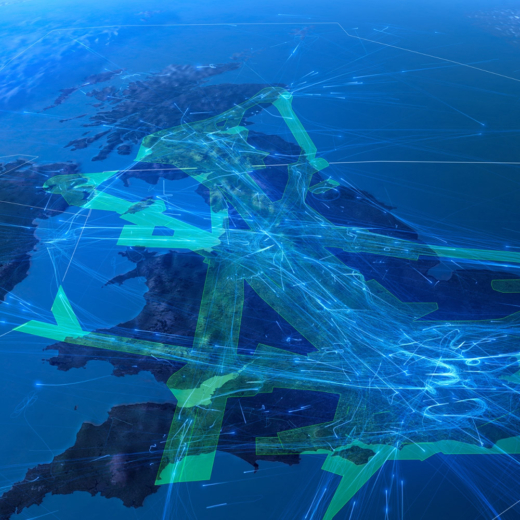
24 hours over London’s skies

Priority one: London and South East England

The London Terminal Control Area (TMA) is one of the busiest and most complex areas of airspace in the world, serving 11 airports across London and southern England.

As UKADS’ first priority, the programme will bring together interconnected airspace changes to develop a coordinated design for the region. This system-wide approach will consider how routes and airport operations work together across shared airspace, helping create a network that can meet future needs safely and efficiently.

The 11 airports involved are: London Heathrow, London Gatwick, London Stansted, London Luton, London City, London Biggin Hill, Farnborough, RAF Northolt, London Southend, Southampton and Bournemouth.

The UKADS journey

NATS began providing UKADS and UKACS by appointment of the UK Government and following changes to its air traffic services licence that took effect on 6 May 2026. The service now sits within an updated policy and regulatory framework including the Air Navigation Guidance and Directions 2026 and CAP1616 version 6, effective from 1 October 2026.

Our immediate priority is the London TMA region, where work is underway to develop plans, technical foundations and engagement arrangements needed to progress a coordinated airspace design. As the programme develops, we’ll share updates on key milestones and progress.

The roadmap below provides an overview of key stages in the development of UKADS, from the regulatory and policy foundations that established the service through to the delivery of the programme.

ALTITUDE

Our aviation themed podcast

Watch here

Placeholder for widget in development.

UK flights

-
Departed today
-
Landed today
-
Currently airborne
-
Handled yesterday

How will UKADS support airspace modernisation?

Complex delivery

Delivering the London TMA project, modernising one of the most complex areas of airspace in the world. Alongside the London TMA, the UKADS coordination service is helping bring together airports, regulators and other airspace users to support the efficient delivery of future airspace modernisation projects.

Coordinated approach

Providing a coordinated approach to airspace change, enabling stakeholders to work together more effectively across shared airspace.

Meeting national priorities

Supporting the delivery of the governments Airspace Modernisation Strategy, helping align local and national priorities.

Navigating complexity

Improving programme efficiency, reducing barriers that can slow the delivery of complex airspace change.

Supporting future aviation

Creating a more integrated airspace network, designed to support future aviation needs while maintaining safety as the highest priority.

Delivering airspace modernisation

Menu

Please start typing and we will search our website for you.

Search Results